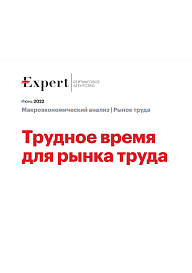
In this report, the rating agency Expert RA studies the latest labor market trends in Russia and globally as well as the specifics of the current economic environment.
The Roscongress Foundation presents the salient points of the publication accompanied by fragments of broadcasts of relevant panel discussions fr om the business programme of international events held by the Roscongress Foundation.
The structural transformation of the labor market triggered by the pandemic gave rise to new trends.
The pandemic has had a huge impact on global economy causing one of the deepest crises in the last decades. The labor market hasn?t been left untouched, with many of its indicators still below the pre-pandemic levels. The report emphasizes the fact that the labor market was hardest hit in lower-middle-income economies wh ere the plunge during the first lockdown was the deepest and where the recovery of demand for labor, as well as overall economic recovery, is the slowest. According to the authors of the report, the effect of the pandemic on developed economies was smaller because they had greater possibilities for transferring employees to remote work, extensive business support programs with the state co-financing salaries if companies retained jobs, higher labor productivity, and higher rates of vaccination. The Expert RA analysts also note that the structure of demand for labor is non-uniform within countries and differs between industries. Besides, the demand varies according to workers? qualifications. The service industry, tourism, and transportation were the hardest hit sectors, with small businesses and workers with medium-level qualifications suffering the most, which is easily explained by the sanitary restrictions.
Importantly, the increase in unemployment caused by the pandemic-driven crisis wasn?t as big as during previous economic recessions of comparable scale. The moderate rise in unemployment was mostly due to the specifics of state support programs and to withdrawal of some part of the population from the labor market.
The report also says that the trends started by the pandemic-driven transformation of the labor market will likely continue even after the pandemic ends and the global economy recovers. Some of these trends are the wider spread of remote work, the Great Resignation (increase in the number of employees who leave jobs of their own accord), growth in the number of freelancers, transformation of the structure of demand for labor, and accelerated automation.
Many global labor market trends are also seen in Russia.
The consequences of the pandemic and the resulting economic crisis have not left the Russian labor market untouched, although, as the Expert RA analysts point out, the blow wasn?t as heavy as in other countries. According to the authors of the report, this is explained by milder restriction policies (for example, a strict lockdown was imposed just once). Another sign that the pandemic has had only a moderate effect on Russia?s labor market is that the rise in unemployment didn?t last long and that the crisis didn?t cause an increase in the share of economically inactive population nor a considerable withdrawal of labor from the market. The authors of the report identify the following reasons for the minimal effect of the crisis on employment indicators. First, the Russian labor market doesn?t typically show any surges in unemployment during crises because workers here are more often ready to accept a pay cut than workers in other countries. Also, many people remained formally employed while actually out of work due to downtimes or shorter working hours. Many companies managed to transfer their employees to remote working.
As for the current trends in Russia?s labor market, they are largely the same as globally, namely the growing popularity of remote work, the Great Resignation, and the rising number of freelancers. The report also mentions an increasingly tough competition for highly skilled labor. The authors of the report name three reasons for this trend. First, when the country?s borders were closed because of the pandemic, fewer migrants were able to come to Russia. The second reason is the entry of the «demographic pitfall» generation into the labor market. Finally, international competition for labor was intensified when many workers received an opportunity to work remotely for foreign companies. The last trend, however, was reversed with the start of the special military operation in Ukraine and the sanctions against Russia. Other recent trends that were caused by the crisis and the sanctions, as seen by the authors of the report, include massive exodus of highly skilled professionals from the country, forced staff leaves due to downtimes, higher unemployment in the medium term, structural transformation of the demand for labor due to redistribution of workforce between economy sectors, and outflow of migrants.
Stricter credit policy might lead to higher unemployment.
Apart from the major changes in the labor market, the pandemic was also a period of an extremely mild monetary policy of leading central banks. According to the simplest economic models, a greater money supply stimulates economic growth, which, in its turn, reduces unemployment. However, as the Phillips curve suggests, a lower unemployment rate is accompanied by a rise in inflation in the short term. Consequently, a higher-than-targeted inflation forces monetary authorities to adopt a tougher policy. For monetary authorities, in Russia and globally alike, this means that the planned counter-inflation measures may lead back to higher unemployment. What?s more, the labor market transformation coupled with a strict monetary policy may lead to long-term unemployment. This is why the authors of the report emphasize that although the world has nearly managed to return to pre-pandemic levels of employment it is advisable to consider possible risks for the labor market when fighting the inflation.
Gain more insights about labor market trends in the Labor Market and Standards of living sections of the Roscongress Information and Analytical System, and about possible ways to stabilize the economy during a pandemic and afterwards in the StayHomeEconomy section.