How to do business in Russia if youre not a man
Today, more and more women are successfully opening businesses in the Russian economy simply because they are interested in becoming entrepreneurs. The Eurasian Womens Forum will be held on 1921 September in St. Petersburg. In the meantime, we decided to investigate the progress women have achieved in business on the basis of several success stories.
Ten years ago, in May 2008, college students Daria Ustyuzhanina, Ludmila Pavlova, and Artem Kiselev sat down to come up with a name for their project. The friends came up with their business when all three were still students at the Higher School of Economics. At the universitys Business Incubator, Ustyuzhanina and Pavlova organized lectures and seminars on entrepreneurship, and Kiselev was responsible for developing the website. Emailed newsletters, a guest database that was kept as an Excel spreadsheet, and endless pages featuring lists of participants all took a lot of time and effort to create and maintain. They needed a tool that would allow them to create lists of participants and automatically generate newsletters. «There was no such solution on the market», says Daria, «so we decided to make our own.»
The new service, which was started on a shoestring budget, made their work so much easier that Ustyuzhanina and her team began to recommend it to friends. Ustyuzhanina continues: «And then it clicked in our heads: we could make this a business.»
The RUB 100,000 that the three of us were able to raise was enough only for design, interfaces, a logo, and domain registration. Investment covered the next tranche of work.
 In 2009, they officially announced the launch of the project. Timepad received an investment of RUB 1 million from a friend. The Foundation for Assistance to Small Innovative Enterprises in Science and Technology then awarded another RUB 1 million and the company was able to hire its first full-time programmer, but there were still no ideas for monetizing the service. Services with paid subscriptions were not particularly popular. Then a new business model was born: sell tickets for events over the Internet and collect a commission on sales.
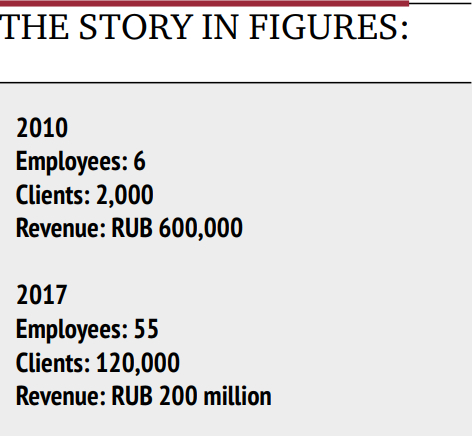
As Ustyuzhanina recalls: «Potential clients at first thought we were crazy.» But then they tried Timepad. The company secured its first 100 clients «literally through in-person demos.» Its revenue in the early days was RUB 10,000 per month. At the beginning of 2010, TimePad had 500 clients; by the end of the year, this had increased to 2,000. But despite the initial successes, the atmosphere became tense. The team burned through its initial RUB 2 million investment, and it seemed that the business was about to collapse.
But, as the saying goes, the darkest hour comes before dawn. You need to have patience. First, Timepad received a small order from the Higher School of Economics, and this was enough to keep the company going for another couple of months. The income started to flow in. A decision to launch a digest of interesting events proved key. This service proved to be popular, and it helped keep the company in business until the ticket sales model started gaining traction.
In 2011, the company managed to break even. Ustyuzhanina notes: «Suddenly we had a viable business. At this point, investors began to seek us out.»
In 2012, the holding company Afisha-Rambler, which launched Rambler Kassa to service large events and cinemas, invested in Timepad. According to the plan, the service would be totally bought out by the holding within several years. But in 2013, when the investors share in Timepad had grown to 49%, a new management team with a new set of requirements took over Afisha-Rambler. The startup team managed to quickly come to an agreement with a new investor: in 2014, Target Global invested USD 1 million in the service, bought out Afisha-Ramblers share, and acquired a 50% stake in the company.
Four years later, at the beginning of 2018, the co-founder of Qiwi, Sergey Solonin, bought up shares from Target Global and Timepads owners for USD 10 million. Ustyuzhaninа, Pavlova, and Kiselev became rich, and they started working for their own company as consultants for the first time.