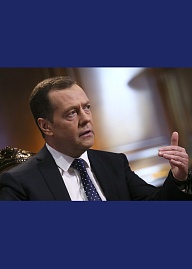
The article titled «Russia-2024: The strategy of social and economic development» by Dmitry A. Medvedev, Chairman of the Government of the Russian Federation, was published in Voprosy Ekonomiki (2018, No. 10, pp. 5–28). The author describes and analyzes the tasks of Russian economic policy for 2018–2024 and suggests a trajectory of economic, social, and technological breakthrough that should ensure sustainable growth of well-being and competitiveness of individuals and the society as a whole.
According to Dmitry Medvedev, the Government of the Russian Federation has managed to prevent further macroeconomic crisis and to relieve burning financial issues without a critical rise of national debt. The current priority areas for structural reforms are human capital (first and foremost — healthcare and education), infrastructure, and public administration. A separate place is given to national projects dealing with strengthening the competitiveness of the economy and aimed at achieving positive results in the areas of labor productivity, employment support, science, digital economy, small and medium businesses, international cooperation, and exports. This should ensure faster technological growth, help develop highly productive export-oriented economy sectors, and facilitate infrastructure development.
The paper also discusses school education and adult education, and raises the question of rearranging the shares of public and private funding for research and development towards increasing the private share. It also raises some issues in medicine and healthcare: medical services personalization, telemedicine, availability of primary health care, etc. Reducing the current poverty rate is one of the priority areas of Russia’s national policy. In this sphere it’s necessary to ensure that social assistance is targeted. One of the key factors for productivity growth is technological modernization and digitalization of the economy. This includes the task of bridging the gap between the most digitally developed companies and the rest of the country’s businesses, which form a substantial portion.
As for national exports, the author states that Russia will not create barriers to international economic relations. Instead, it will head towards liberalizing foreign trade and increasing exports of services. Non-commodity exports must become an indicator of the success of the import substitution policy. Besides, to reach the said goals, the country must have an effective, comprehensive tax and budgetary policy, which should combine solutions for fiscal, economic (stimulating business activity), and social tasks.