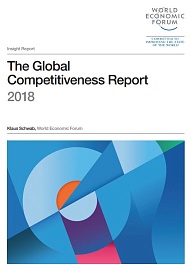
The analysis presented in the Global Competitiveness Report 2018 is based on a methodology integrating the latest statistics from international organizations and a survey of executives. The methodology, developed in collaboration with leading experts and practitioners through a three-year consultative process, is designed to support countries in identifying relevant policies and practices.
This year, the World Economic Forum experts introduce new concepts, new benchmarks, and a new progress score ranging from 0 to 100. Also, they present their conclusions on burning macroeconomic issues. All national economies must invest in broader measures of competitiveness today to sustain growth and income in the future. Enhancing the fundamentals of competitiveness today will improve resilience to shocks. Technology-based leapfrogging remains elusive. The promise of leveraging technology for economic leapfrogging remains largely unfulfilled. Weak institutions defined as including security, property rights, social capital, checks and balances, transparency and ethics, public-sector performance, and corporate governance continue to hinder competitiveness, development, and well-being in many countries. While openness is good for growth, governments must support those who lose out to globalization.
As a result of their analysis, the WEF experts introduce a new tool for assessing competitiveness of national economies the Global Competitiveness Index 4.0, or GCI 4.0 2018, which reflects the ability of economies to compete with others in the context of the Fourth Industrial Revolution. The indicators in the Index are organized into 12 «pillars» which represent the key factors for national incomes and for long-term economic growth. The pillars are: Institutions; Infrastructure; ICT adoption; Macroeconomic stability; Health; Skills; Product market; Labor market; Financial system; Market size; Business dynamism; and Innovation capability.
.png)
The authors scrutinize 140 economies by studying the above components of the GCI 4.0 2018 which determine the level of productivity and competitiveness. After that, the authors proceed to give final rankings. The report also provides regional highlights. For example, of the BRICS grouping of large emerging markets, China is the most competitive, ranking 28th. It is followed by the Russian Federation, which is ranked 43rd. Next is India, which ranks 58th. The rankings highlight global economic inequality: Europe and North America are, combined, home to 7 of the 10 most competitive economies, while at the other end of the spectrum, 17 of the 34 sub-Saharan African economies studied are among the bottom 20 globally.
.png)