Invest in Russia — invest in Russian regions!
All analytics

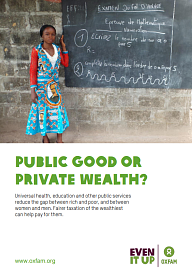
Public Good or Private Wealth?

Research
19 March 2019
Общественное благо или частный капитал
Source
Release date
01/21/2019
Open PDF

This report was published by Oxfam International on the threshold of the World Economic Forum in Davos, Switzerland. According to the data collected by the authors of the report, billionaire fortunes increased by 12 percent last year — or $2.5 billion a day — while the 3.8 billion people who make up the poorest half of humanity saw their wealth decline by 11 percent. The report reveals that the number of billionaires has almost doubled since the financial crisis, with a new billionaire created every two days between 2017 and 2018, yet wealthy individuals and corporations are paying lower rates of tax than they have in decades. Just four cents in every dollar of tax revenue collected globally came from taxes on wealth in 2015. Also, tax revenues from taxes on wealth were growing at a slower rate than revenues from other types of taxes.

The authors of the report state that governments are exacerbating inequality by underfunding public services, such as healthcare and education, on the one hand, while undertaxing corporations and the wealthy, and failing to clamp down on tax dodging, on the other. At the same time, public services are suffering from chronic underfunding or being outsourced to private companies that exclude the poorest people. In many countries a decent education or quality healthcare has become a luxury only the rich can afford. Every day 10,000 people die because they lack access to affordable healthcare. In developing countries, a child from a poor family is twice as likely to die before the age of five than a child from a rich family.

Women and girls are hardest hit by rising economic inequality. Girls are pulled out of school first when the money isn’t available to pay fees, and women clock up hours of unpaid work looking after sick relatives when healthcare systems fail. Oxfam estimates that if all the unpaid care work carried out by women across the globe was done by a single company it would have an annual turnover of $10 trillion — 43 times that of Apple, the world’s biggest company.

Oxfam insists that all governments should set concrete, timebound targets and action plans to reduce inequality as part of their commitments under Sustainable Development Goal (SDG) 10 on inequality. These plans should include action in the following three areas:
  • Deliver universal free health care, education and other public services that also work for women and girls.
  • Free up women’s time by easing the millions of unpaid hours they spend every day caring for their families and homes.
  • End the under-taxation of rich individuals and corporations.
Anlytics on the topic

All analytics
Research
31 May 2021
SDG Investment Trends Monitor. April 2021

The UNCTAD study analyzes the impact of COVID-19 on investments in the UN Sustainable Development Goals by goals, objectives and sectors.

Research
24 April 2020
African Industrial Capacity Towards Critical Pharmaceutical and Medical Supplies

On the Roscongress Foundation portal ‘Anticrisis Plan. Global Best Practices’ and in the ROSCONGRESS.ORG Information and Analytical System a report has been posted on the impact of the COVID-19 coronavirus pandemic on the economies of African countries.


Research
30 August 2021
Payment Discipline in Russian Electricity Sector: End Consumers Build Up Debt

The study prepared by experts of the Analytical Credit Rating Agency (ACRA) analyzed data on consumption and debt dynamics in the Russian wholesale and retail electricity markets in early 2021.

Research
7 February 2018
Russian Federation Civil Society Report 2017

The Civic Chamber of the Russian Federation presents the Report on the state of civil society in the Russian Federation for 2017. Civil society is the aggregate of caring and active citizens engaged in the shaping of their common future. No country can develop without a civil society. Even less so a country of Russia’s scale and complexity that spans so many diverse regions.