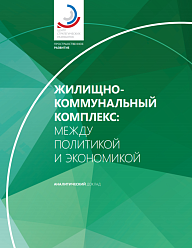
Housing and communal complex (FCC) is present in every corner of our vast country, to a greater or lesser extent. Its turnover is more than 4 trillion rubles a year with payments of the population at the level of 2 trillion rubles a year. This is more than 3% of Russias GDP.
Within the framework of communal infrastructure, the political task is formed with the utmost simplicity ‒ high quality services, reliable systems and affordable payments. The high priority issue of the current state regulation is the abuse of centralized decision-making powers. It is necessary to form the relevant institutions, establishing the «rules of the game» therewith.
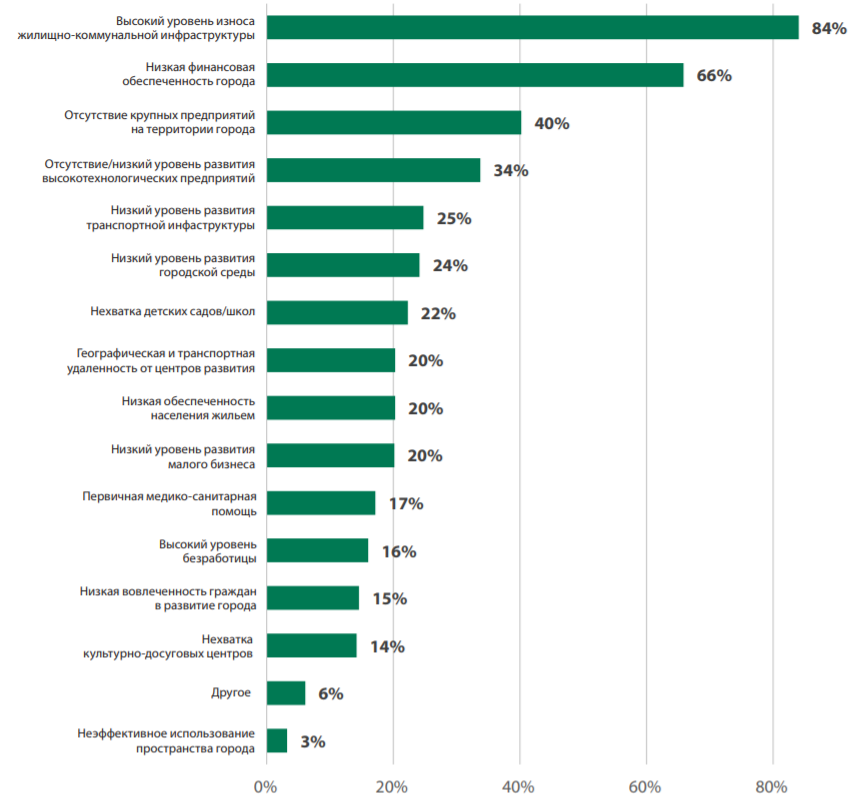
The report addresses key issues of residential real estate management. There is a problem related to the objectively complex structure of the propertys owners. A system of ownership responsibility for the state of the object is required, as well as a system for making decisions and taking full responsibility for these decisions, and a system of delegation of powers. In international practice, the owners of the premises form an owners association, in which they are responsible for the obligations of the association within their share of the property. Moreover, there is a problem in the management and maintenance of apartment buildings. Potentially competitive business turned out to be administratively regulated. In Russia, the costs of maintaining residential real estate and utility costs are correlated by a proportion of 20/80, respectively. The endemic problem is that the management companies do not ensure complete collection of public utility charges from every single apartment (a situation that is not found anywhere in the world). In terms of capital repairs, it is necessary to introduce the following key principles: voluntary participation, the involvement of the banking sector in lending to homeowners associations and budget grants that depend on the energy-savings effect.
A number of problems was also highlighted in the utilities sector. The main problem lies in the payables to the energy sector in utility tariffs that do not cover current costs. In this regard, it is necessary to provide financial coverage of the already existing costs, and to consider these unproductive costs as investment potential. Moreover, this problem is eliminated by delegation of authority on tariffication down to the municipal level.
The strategic task is to make a financial maneuver without a significant change to the amount of funding: spending more on housing services and less on the municipal ones. To do this, it is necessary to ensure the possibility of obtaining the apartment buildings energy balances by changing the ownership of metering devices, form a set of measures to support the housing modernization based on the initiative of private owners, reduce administrative barriers in the field of professional management of residential property, as well as ensure the formation of subtle support mechanisms of low-income households by government authorities. In the utilities sector, it is necessary to transfer price risks to public authority to ensure private sector investment in the sector through PPP. In addition, the development of special mechanisms for debt financing of public utilities by the public sector will also contribute to the achievement of the final goal.
The proposed approaches, outlined in the report, allow to achieve a multiplicative effect ‒ to provide a significant update and modernization of the systems and facilities of the housing and utilities sector, to improve the efficiency and reliability of the housing and utilities complex, to contain the increase in utility prices while at the same time ensuring their high quality.