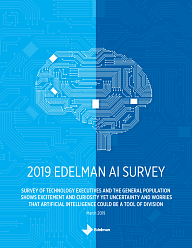
Born in the 1950s, artificial intelligence (AI) is hardly new. After suffering an «AI Winter» in the late 1980s, recent advances with more powerful computers, more intelligent software and vast amounts of «big data» have led to breakneck advances over the last several years mostly based on the «deep learning» breakthrough in 2012. Management consulting group McKinsey forecasts that AI will add $13 trillion to the global economy by 2030. Every day, there are headlines extolling the latest AI-powered capability ranging from dramatic improvements in medical diagnostics to agriculture, earthquake prediction, endangered wildlife protection and many more applications. Nevertheless, there are many voices warning about a runaway technology that could eliminate jobs and pose an existential threat to humanity.
.png)
This publication seeks to determine current viewpoints but also to compare perceptions of the public with those of people who work most closely with technology. This latter group is called the «tech execs» here as they work daily in development or deployment with leading technologies. The study shows that nearly 9 in 10 survey respondents from both groups believe AI is transformational, and that it is leading to a technological revolution. Both groups are generally optimistic about the long-term impact of AI though the results demonstrate that the tech execs are more so. This optimism delta between the groups was consistent across almost every question. Responses clearly show both groups expect AI to provide business benefits across every industry.
However, the survey also reveals some very real and troubling concerns. Majorities of both groups believe that initially, AI will eliminate more jobs than it creates and lead to greater income inequality. Some experts predict that AI technologies are going to displace about 40 percent of the jobs in the world. Strong majorities believe that the wealthy will benefit from AI while nearly half expect the poor will be harmed. Additionally, there are also concerns by nearly 70 percent about the potential loss of human intellectual capabilities. Furthermore, 7 in 10 respondents are concerned about growing social isolation from an increased reliance on smart devices.
.png)
The survey reveals the many positive benefits but also the potential that AI can be a powerful tool of division. Nearly 70 percent believe AI interjects greater possibilities for digitally enhanced «group think,» lessening creativity and freedom of thought. AI thrives on a lot of centralized information. As autocratic powers are able to access and leverage that content, they could increasingly control the levers of disinformation thereby further manipulating their populations. Adding to that, nearly half expect AI-generated deepfake audio and visuals will further erode public trust in what is real, which could lead to societal disruption. Majorities of survey respondents said that technology companies must demonstrate transparency and social benefits with respect to AI operation.
Still, given a choice of words to describe how respondents feel about AI, «curiosity» wins out over «fear,» and this is what drives us forward despite the apparent risks.