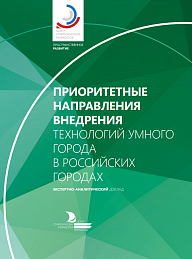
In the context of the global technological revolution, an intellectualization of urban development processes in accordance with the rapidly developing concept of smart cities becomes inevitable for Russian cities, too. Given the key role of cities in Russia’s national economy and the fact that around 74% of Russian citizens live in cities, urban development policies must become the focus of government attention and be implemented via a system of goal-oriented actions. The report prepared by the Center for Strategic Research studies the main principles of current approaches to urban development management in Russia. The authors note that Russian cities face a number of challenges that hinder their progress. These challenges include infrastructure gaps and run-down main urban infrastructure, shortage of budget resources, increased ecological pressure, growing demands from the population for a higher quality of urban environment and better security, etc.
Most issues related to these challenges can be resolved by implementing the concept of a smart city, which involves a transition to a data-driven city, meaning an intellectualization and digitalization of urban development achieved via a number of transformations. At the same time, given a number of existing factors, it’s perfectly possible that Russian cities will adopt the implementation of the smart city concept as their target. Importantly, municipalities can choose different strategies depending on their local specifics and implement different models of digital transformation: decentralized (for million-plus cities), centralized (for large and medium-size cities), or local-action model (for smaller cities).
The main obstacles to digital transformation in Russian cities include, on the one hand, barriers to developing new technological solutions, and on the other hand, legal, organizational and technical issues faced by municipalities and businesses. Given these obstacles, the first step towards creating the right conditions for a techno¬logical transformation of Russian urban ecosystems must involve a profound moderni¬zation of the regulatory framework, as the core challenge in the way of implementing the smart city concept in Russian cities is currently connected with resource constraints faced by municipalities and an imbalance between jurisdictions, rather than with technological development.
In this respect, a reform of the current system of delineation of authority, as well as budget and tax regulation, becomes a strategic goal. Also, a special legal regul¬ation framework aimed at stimulating the implementation of relevant techno¬logies, must be introduced.
Besides describing possible models of digital transformation, the report offers specific recommendations related to changes in this sphere. The authors believe that the key action needed to initiate the processes of intellectualization and digital transition in Russian cities is launching pilot projects in specially selected test areas. Such test areas may take the form of specialized test locations (test beds), including «living laboratories», where priority digital solutions could be tried out, but may also include whole cities if their management specifics allow for testing a solution on a territory-wide scale (such as ZATOs — closed administrative territorial formations, i.e. closed cities).