The Intergovernmental Panel on Climate Change (IPCC) is an intergovernmental body of the United Nations, dedicated to assessing the available scientific information about climate change. The IPCC was founded in 1988 for the purpose of regularly providing policymakers with expert opinions about climate change, its impacts and potential risks, and of proposing adaptation and mitigation strategies. By assessing scientific literature, IPCC provides authorities at all levels with scientific information to be used when devising climate-related policies.
The IPCC Special Report on the Ocean and Cryosphere in a Changing Climate was formally approved by 195 IPCC member states on 24th September 2019. This Summary for Policymakers compiles key findings of the report and is structured in three parts: A: Observed changes and impacts, B: Projected changes and risks, and C: Implementing responses to ocean and cryosphere change.
The report outlines the threat to hundreds of millions of people from the acceleration in the rate at which sea levels are rising, caused by a combination of melting ice in polar regions such as Greenland and Antarctica and the expansion of the oceans as the water warms. The researchers warn that extreme floods, the likes of which have historically only occurred once per century, are likely to happen at least once per year by 2050 in many regions, especially the tropics, even if global warming is limited to 1.5°C.
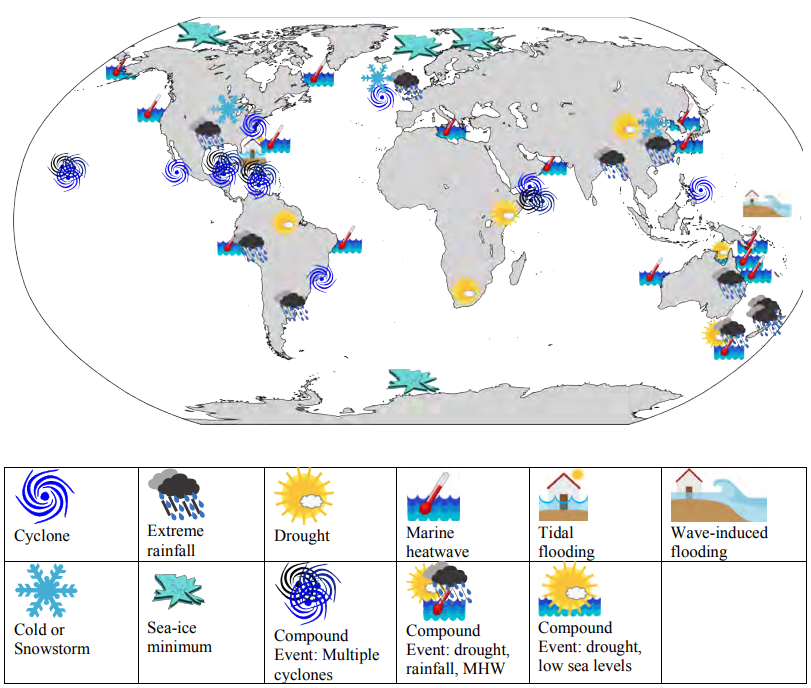
Coastal flood damages are projected to increase by «two to three orders of magnitude by 2100 compared to today» if lawmakers fail to plan for rising sea levels, the report says. Coastal cities will be at «moderate to high» risk after 2050 if «transformative» plans are not put in place, while Arctic communities will be at risk in all scenarios. Changing marine habitats are likely to lead to a widespread loss of marine animal and plant species, as well as coral reefs, throughout this century. This will affect the livelihoods, income and food security of marine-dependent local and indigenous communities, the report says.
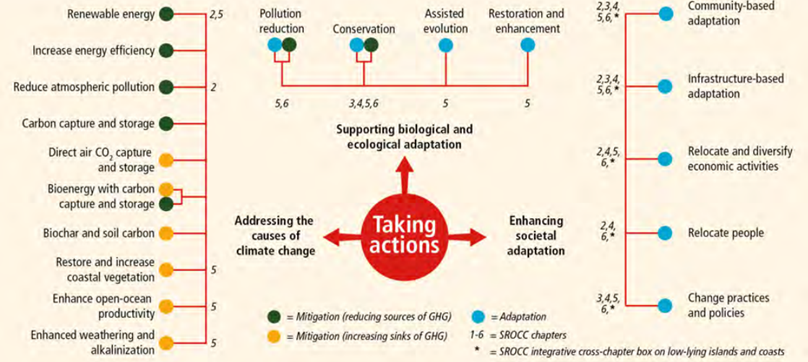
The researchers give an overview of the main ocean-cryosphere mitigation and adaptation measures to observed and expected changes in the context of this report. These measures include increased use of renewable energy; reducing atmospheric pollution; carbon capture and storage; enhanced weathering and alkalinization; restoring and increasing coastal vegetation, etc.