Invest in Russia — invest in Russian regions!
All analytics

Pulse of Small Business

Research
27 November 2019
Пульс малого бизнеса
Source
,
Release date
08/02/2018
Open PDF

Small Business Sentiment Index


The study conducted by Alfa-Bank in collaboration with the international research company MARC aims to calculate the Small Business Sentiment Index, compare it with the index values of previous years, and assess the results. The study is based on an online survey of Alfa-Bank clients (legal entities and individual entrepreneurs with annual revenue of up to 350 million rubles) in the cities of Alfa-Bank’s presence in Russia.

In calculating the Small Business Sentiment Index the analysts used the following indicators: business expectations of companies, their financial standing and plans for the future, sales and number of clients, export and import, business development involving the bank, and business profile. First, the following four intermediate indexes were calculated: current situation index, business expectations index, company standing index, and company expectations index. Then, these were combined to form an aggregate intermediate index, based on which the final Index was calculated.

The level of small business sentiment matches that of November 2017


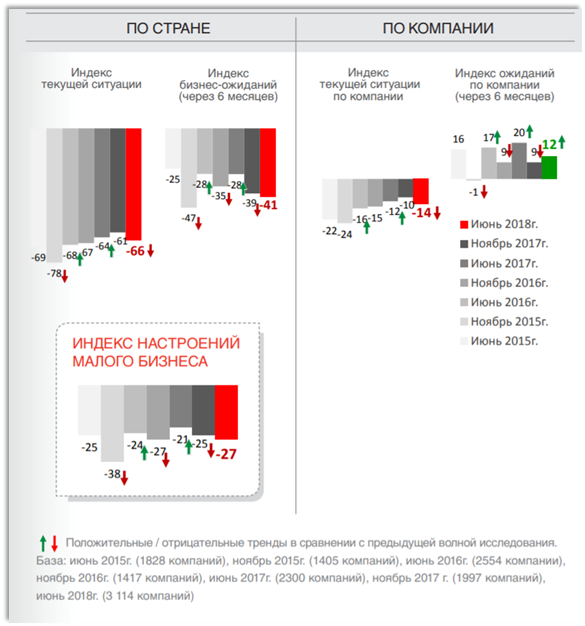
Based on the results of the calculation, the analysts arrived at a conclusion that the Small Business Sentiment Index remained at the level of November 2017. Despite the growing prevalence of negative opinions about the current situation in their company, industry, and the country on the whole, entrepreneurs increasingly often state that they expect positive changes in the nearest six months.
To note, the study not only assesses the current situation but also gives company development forecasts based on a number of parameters such as the company’s current level of success, time period required by the company to succeed in business, and criteria for measuring success. When asked about the main indicator of business success, 46% of the respondents cited high revenues as the principal criterion, 44% singled out an opportunity to expand the business to related spheres or industry sectors, and 43% mentioned creating products or services of the highest quality.

The publication also examines regional and industry-specific features of small businesses, and touches upon the dependence of companies on export/import or on their relationships with foreign suppliers. Also, the report identifies some problems of small businesses. The majority of the respondents (46%) named high taxes as the main problem. Notably, 14% of the respondents stated that they had to rearrange their business processes to comply with new regulation.

Separate consideration is given to investment in business process automation and the use of digital technologies. It was discovered that 68% of respondents are actively investing in business process automation and digital technologies.

The final section of the publication gives statistics to present a generalized profile of small business in Russia.

This publication has been posted in the Roscongress Information and Analytical System on the recommendation of the Roscongress Foundation expert community.

Anlytics on the topic

All analytics
Articles
23 December 2019
Ekaterina Petrova: Startups can help corporations meet ambitious targets

In an interview to Inc., Ekaterina Petrova, Managing Director of GenerationS, a federal-level tech startup accelerator organized by the Russian Venture Company, spoke about the advantages that searching for new startups gives to traditional industries and about ways to implement tech projects in corporations.

Research
27 March 2020
Beyond banking: How banks can use ecosystems to win in the SME market

The work by the McKinsey & Company consultancy explores SME development, challenges faced by SMEs, and the process of building an effectual ecosystem which would help businesses meet the challenges and would, at the same time, be profitable for banks.

Research
17 June 2020
Supporting businesses in financial distress to avoid insolvency during the COVID-19 crisis

The Organisation for Economic Cooperation and Development has prepared analytical research on business support mechanisms to avoid insolvency during the COVID-19 crisis. The slowdown of economic activity caused by the COVID-19 outbreak and related emergency measures implemented to tackle the health crisis have led to severe difficulties for companies to meet their financial obligations. Many of the fixed costs, such as rents and interest payments, remain due while the cash flow destined to meet these obligations has vanished. As a result, many otherwise sound companies are facing acute liquidity constraints that eventually might become solvency problems.

Research
8 July 2020
The US Sovereign Debt Is No Longer The #1 Asset

Expert RA, Russia’s largest rating agency issues the analysis ‘The US Sovereign Debt Is No Longer The #1 Asset. It is the first report on international financing and investment, which also touches on strategies and development projects, including Public Private Partnerships.