Global economic growth
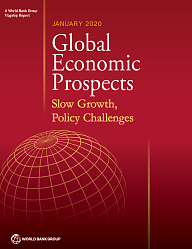
According to the World Bank, global growth is projected at 2.5 percent in 2020, just above the post-crisis low registered last year. While growth could be stronger if reduced trade tensions mitigate uncertainty, the balance of risks is to the downside. A steep productivity growth slowdown has been underway in emerging and developing economies since the global financial crisis, despite the largest, fastest, and most broad-based accumulation of debt since the 1970s. These circumstances add urgency to the need to rebuild macroeconomic policy space and undertake reforms to rekindle productivity.
Growth in almost all EMDE (emerging market and developing economies) regions has been weaker than expected, reflecting downgrades to almost half of EMDEs. Activity in most regions is expected to pick up in 2020-21, but the recovery will largely depend on a rebound in a small number of large EMDEs, some of which are emerging from deep recessions or sharp slowdowns.
Decline in labor productivity growth
Separate consideration in the report is given to the problem of a decline in labor productivity growth. The pace of improvements in key drivers of labor productivity—including education, urbanization, and institutions—has slowed or stagnated since the global financial crisis and is expected to remain subdued.
Global labor productivity growth slowed from its pre-crisis peak of 2.7 percent in 2007 to a trough of 1.5 percent in 2016 and since then has remained low, at 1.9 percent in 2018. Productivity growth in EMDEs has slowed sharply from its 2007 peak of 6.6 percent to a low of 3.2 percent in 2015 and, since then, has inched up to 3.6 percent in 2018. Meanwhile, productivity growth is the primary source of lasting income growth, which in turn is the main driver of poverty reduction.
According to the World Bank, to rekindle productivity growth, a comprehensive approach is necessary: facilitating investment in physical, intangible, and human capital; encouraging reallocation of resources towards more productive sectors; fostering firm capabilities to reinvigorate technology adoption and innovation; and promoting a growth-friendly macroeconomic and institutional environment. Specific policy priorities will depend on individual country circumstances.
Price controls and drivers of the long period of low inflation
Additional key themes explored in this edition include price controls—which, despite good intentions, can dampen investment and growth, worsen poverty outcomes, and lead to heavier fiscal burdens—and the drivers of the long recent period of low inflation among low-income countries and necessary policies to maintain low and stable inflation.Debt accumulation
Another theme is debt accumulation. The global economy has experienced four waves of debt accumulation over the past fifty years. The first three ended with financial crises in many EMDEs. During the current wave, which started in 2010, the increase in debt in these economies has already been larger, faster, and more broad-based than in any of the previous three waves. Since the 2008-09 global financial crisis, another wave has been building, with global debt reaching an all-time high of about 230 percent of global GDP in 2018.
Political reforms
Yet, the authors of the report assert, policymakers have it in their capacity to ensure the recovery not only stays on track, but even surprises to the upside. Recent policy actions— particularly those that have mitigated trade tensions could augur a sustained reduction in policy uncertainty. Countries could pursue decisive reforms to bolster governance and business climate, improve tax policy, promote trade integration, and rekindle productivity growth, all while protecting vulnerable groups. Building resilient monetary and fiscal frameworks, instituting robust supervisory and regulatory regimes, and following transparent debt management practices could reduce the risk of shocks, or soften their impact, and strengthen resilience against them.
Overall, according to the World Bank, there are signs that global growth has skirted a rough patch and is recovering; now it is up to policy makers to make sure it thrives.