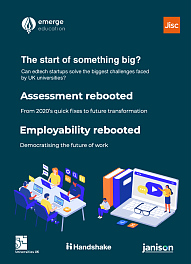
Jisc experts collaborate with Emerge Education to present the series of Education Technology (edtech) reports.
The reports detail aspects of each priority area, compare current approaches and challenges, and highlight specific edtech solutions and startups. The reports draw on the experiences of higher education leaders, employers, and startups gathered through Jisc Advisory Groups in collaboration with Emerge Education on specific topics including the future of assessment, employment paths for non-traditional societies’ students, graduates recruitment in times of crisis, employer-university collaboration, and challenge mental health and wellbeing of students.
Roscongress Foundation analysts highlighted the main theses of these researches, accompanying each of them with suitable fragments of video broadcasts of panel discussions held as part of business programs of the key events hosted by the Foundation.
Universities express a strong desire to innovate, but often face obstacles to their implementation. Edtech startups can help higher education institutions both implement technology more gentle and solve other pressing problems.
The report "Start of Something Bigger? Can educational technology startups solve the traditional problems facing UK universities? reviews edtech startups as the key to innovation and flexibility that higher education needs to navigate the rapidly changing present and future. The authors of the study direct the main focus on understanding the urgent challenges that universities executives will face in the very near future.
In addition, the report highlighted the unmet needs of universities and the areas where startups can benefit the most. Universities expressed a strong desire to innovate but have not always been able to do so due to a number of persistent barriers.
Assessment of student performance is one of the most important aspects of university activities. Thanks to modern technologies, great potential is opening up in this area. At the same time, the events associated with the COVID-19 pandemic have accelerated the introduction of such technologies.
The report "Assessment Practice and Learning Outcome Measurementhas been reloaded. From Corrections to Foresight «covers issues related to online testing of students. In a very short time, higher education institutions were forced to transfer their learning assessment in remote mode. At the same time, they had to ensure the reliability of assessment mechanisms, monitor attendance, and also ensure stable communication between teachers and students who had to prepare and pass their tests in difficult circumstances.
Assessment and measurement of learning outcomes is fundamental to all education systems. Unlike elementary and secondary education, universities can define their own approaches to assessment, with each university free to innovate according to its specific circumstances and mission. Over the past years, universities have looked at the potential of new technologies — opportunities for new approaches to assessment combined with increased efficiency and cost for institutions, and efficiency for students and teachers.
Graduates of 2020 must go through a rather difficult path to their dream jobs. Despite the negative impact of the coronavirus crisis, there are trends associated with digitalization that improve the employment prospects of students from various societies.
The report «Restarting Employment: Democratizing the Future of Work» examines the student-graduate journey from university entrance to first-time workplace experience and focuses on key interactions and touchpoints between students, universities and employers along the way.
The first part examines the immediate crisis and the impact of COVID-19 on the «bridge to work» of the 2020 graduation course. A recent survey of prospects of 5,000 students found that 29% of undergraduate students lost their jobs, 26% lost their internship, while 28% of them postponed or canceled their postgraduate job offers. According to the latest data from the Institute for Financial Research, the number of vacancies at the end of March was only 8% of their level in 2019.
See other materials posted in special sections of the Roscongress Information and Analytical System StayHomeEconomy, Education and FriendsforLeadership, dedicated to possible ways to stabilize the economy in a pandemic, as well as the development of education and the implementation of youth policy.