Invest in Russia — invest in Russian regions!
All analytics

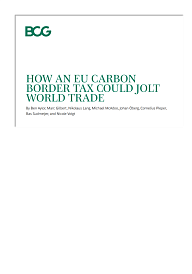
How an EU Carbon Border Tax Could Jolt World Trade

Articles
9 October 2020

The Boston Consulting Group has prepared a report on the impact on global trade of initiatives to fight climate change and protect the environment, in particular, the EU Carbon Border Tax.

Although the policy has important proponents in Europe, it would create serious near-term challenges for companies with a large greenhouse gas footprint—and a new source of disruption to a global trading system. A European carbon border tax would impact, either directly or indirectly, all industrial sectors that rely on imports into the EU and would influence sourcing decisions throughout entire value chains.

To assess the potential impact of the carbon border tax, authors analyzed a selection of carbon-intensive industrial sectors—semimanufactured gold, bituminous coal, mechanical and chemical wood pulp, crude oil, and flat-rolled steel products. In each examined sector the tax’s impact would be significant.

The authors note that, the EU carbon border tax would also transform the competitive landscape of several industries by putting producers with highly carbonintensive processes at a strong disadvantage, compared with EU companies or foreign competitors that have a smaller carbon footprint.

The paper also provides tips for CEOs: although the exact mechanics and timing of a carbon border tax must still be determined and approved by legislators, CEOs should begin preparing now.

For more information about measures to combat climate change and protect the environment, please see the Trade policy, Globalization/regionalization, Environment and Climate Change.
Anlytics on the topic

All analytics
Research
4 September 2022
Russia's External Climate Challenges Monitoring

This report by the Center for Strategic Research (CSR) deals with issues currently on the climate agenda in Russia and globally.

Research
23 January 2018
21st CEO Survey The Anxious Optimist in the Corner Office, 2018

Every year, PwC conducts a large-scale survey of the CEOs of leading companies worldwide for deep and comprehensive understanding of key challenges facing global business leaders. In the 21st survey, PwC explored CEO views on trust and tenure; how public confidence in business has fallen along with trust in other major institutions of society. This year, 1,293 company executives from 85 countries took part in the survey. The results were presented at the World Economic Forum in Davos (WEF).

Articles
31 October 2019
Prospects of Development of Trade Relations in the Caspian Region for the Russian Federation

The article discusses key issues related to the development of the Caspian region. The main direction of international cooperation in the development of this territory is the intensification of trading activities, which in turn will allow all countries in the region to increase their economic potential. Already today, the Caspian region attracts the attention of investors and in order to further strengthen trade activities, it is necessary to overcome the obstacles that today have a negative impact on the development of cooperation in the Caspian space. Within the framework of a large Eurasian region, the Caspian basin plays a significant role and, in case of successful development of infrastructure in this region, can bring economic benefits to all participants in trading activities.

Research
22 July 2019
Belt and Road Transport Corridors: Barriers and Investments. Report No. 50, 2018

The report by the EDB Centre for Integration Studies presents an analysis of the impact that international freight traffic barriers have on logistics, transit potential, and development of transport corridors traversing EAEU member states.