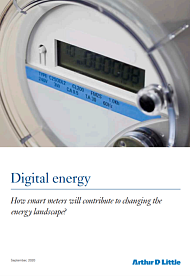
Consulting firm Arthur D. Little has prepared a study on the implementation of smart metering in the electricity market in the EU.
The Roscongress Foundation presents the salient points of the publication accompanied by fragments of broadcasts of relevant panel discussions from the business programme of international events held by the Roscongress Foundation.
The European Union has supported the diffusion of advanced measurement systems over the last decade, with the aim of fostering the development of smart grids and intelligent measurement systems
The first Directive, 2009/72, required Member States to perform CBAs for the massive rollout of smart meters and, in the case of a positive outcome, set the objective to reach a penetration rate of 80 percent by 2020. Directive 2012/27 provided a new definition for smart-metering systems, underlining the importance of the timely availability of measuring data, in order to enhance consumers’ awareness of their consumption habits.
The «Clean Energy Package» presented by the EU in November 2016 pursued the objective, among others, of enhancing the transition towards smart grids.
It is noted, that about three-quarters of Member States have incorporated the Electricity Directive into national laws and defined their own implementation strategies, regulated by specific pieces of legislation for deployment of smart meters. Only four states (Belgium, Bulgaria, the Czech Republic and Croatia) have not defined implementation strategies yet.
On the basis of the obligations set by Directive 2019/944, every Member State, except Spain and Malta, has completed at least one CBA.
Italy is at the forefront of smart-metering rollouts
Italy has been at the forefront of smart-metering rollouts during both waves, having started its first-generation smart-meter rollout in the early 2000s (and completed it in 2012, with most smart meters installed in the first years). It was also the first EU country to start its rollout of the second generation of smart meters in 2017, following a deliberation by the Italian Regulatory Authority for Energy, Networks and Environment (ARERA).
ARERA defined the fundamental technical and functional specifications that new-generation smart meters must have and set some rules in relation to cost recognition in tariffs, timing of the 2G rollout, and transparency of service plans provided by operators.
The smart-metering rollout will be beneficial for all actors along the value chain
The main benefits can be summarized as follows: Remote reading and management, Near-real-time reading, Dynamic pricing offers, Smart-home offers/Chain.
The new system will also facilitate the development of demand-response, energysharing systems and microgrids, helping individuals in the transition from consumers to prosumers in the market, as well as utilization of electric vehicles and home batteries that would be impacted by lower costs for charging.
In conclusion, benefits from smart metering will reshape the value propositions of different market players, enabling integration with advanced systems based on new technologies and providing new value-added services to the customers.
It is worth noting, that smart metering represents one of the key strategic items towards smart-city development, thanks to the aforementioned benefits embedded throughout «electricity value chain».
Video: https://roscongress.org/sessions/eef-2018-umnyy-gorod-ot-teorii-k-praktike/search/#01:15:22.495
For more information about response to the coronavirus outbreak and possible ways to stabilize the economy in the face of a pandemic, please see the Artificial Intelligence, AI, Digitalization, Electronics and Power generation.