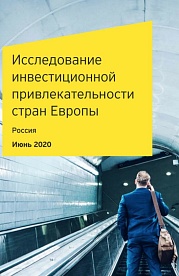
EY experts presented a study that identifies the dynamics of foreign direct investment (FDI) in Europe at the time of the pandemic crisis. Digital technology and business services are leaders in the number of FDI projects. 66% of respondents expect decrease in investment activity in 2020. Despite the difficult economic situation, previously launched projects are still being implemented and new deals are being made.
The Roscongress Foundation presents the salient points of the publication accompanied by fragments of broadcasts of relevant panel discussions from the business programme of international events held by the Roscongress Foundation.
2019 was one of the most successful years for Europe in terms of foreign direct investment attracted, but the coronavirus outbreak led to a sharp decline in FDI.
According to the EY analysis, in 2019 6,412 investment projects with FDI were announced in Europe, which was 0.9% more than the year before. The pan-European dynamics have been rather modest, due to increased tension in international trade relations, uncertainty around Brexit, and sluggish economic growth. The EY analysis shows that the uncertain market situation and its contraction in case of a number of industries will result in only 65% of the projects announced in 2019 being implemented on time.
The pandemic has curtailed investors’ ambitions about foreign direct investment, but has not reduced it dramatically, so the pace of FDI recovery will largely depend on economic support measures by the government.
Due to the pandemic, investors were forced to adjust their plans for the European market, but they do not intend to abandon them completely. According to the survey conducted at the end of April 2020 in 113 companies, 51% of investors are going to slightly reduce the planned volume of FDI for 2020. Due to the uncertainty caused by the pandemic, companies have to re-examine their production, R&D and support plans for economic viability. According to the Companies` Confidence Barometer survey conducted by EY, 73% of companies expect the pandemic to cause serious damage to the global economy. It should be noted that a number of countries are highly dependent on US investments.
In the post-coronavirus world, the following factors will have a decisive impact on investment decisions: acceleration of technological changes, increased attention to climate change and sustainable development issues, as well as restructuring of supply chains and reconsideration of procurement priorities in foreign countries and neighboring countries and in the country.
In the near future, 55% of companies plan to increase the availability of digital services to customers, to virtualize B2C interaction models, as well as to more actively engage e-commerce mechanisms. Digital competitiveness of the national economy, the availability of appropriate skills and infrastructure, and the dynamic technology sector are the factors that have long played a determining role in choosing the country for investment. In order to increase the attractiveness of countries for foreign investors and expand the geography of FDI beyond large urban agglomerations, rapid Internet access should be made available everywhere and effective communication channels should be established in selected areas.
Video: https://roscongress.org/sessions/iif-2019-umnyy-gorod-ot-teorii-k-praktike/search/#01:09:36.127
Production is always the most attractive industry for investment in Russia. A decrease in foreign companies’ activity in Russia has not been noticed.
Despite the fact that the number of FDI in Russia is decreasing, the overall index in terms of the number of FDI projects in Russia is still high compared to previous years.
All over the world companies had to revise their investment plans due to the COVID-19 pandemic and falling oil prices. According to Alexander Kozlov, Minister of the Russian Federation for the Development of the Far East and the Arctic, the pandemic has imposed misprints on business processes, but the work «is far from being collapsed».
For more information about construction as a sector with a sizeable share in many economies, rising level of digitalization, and shifts in consumer sentiment in real estate, please see the Digitalization, StayHomeEconomy, Investment climate and Foreign direct investment