The publication by the credit rating agency Expert RA assesses the current state of the SME lending market in Russia as of the year end 2020 and explores its prospects for 2021. The study is based on official Bank of Russia statistics and on the results of a survey of banks.
The Roscongress Foundation presents the salient points of the publication accompanied by fragments of broadcasts of relevant panel discussions from the business programme of international events held by the Roscongress Foundation.
Despite the negative impact of the pandemic and the restrictions on SME activities, a sharp drop in the SME lending segment was averted.
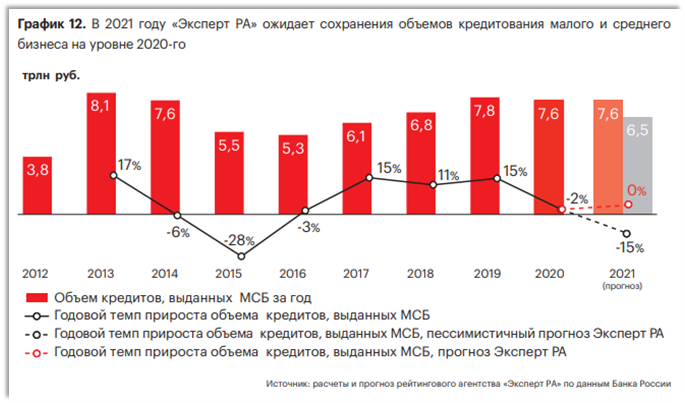
The volume of SME loans last year declined only slightly compared to 2019. The total volume of loans to SMEs in 2020 was RUB 7.6 trillion, only 2% lower than in 2019. The authors of the report point out that while there was a surge in demand for loans in the SME segment in 2020, total SME debt also increased by nearly 23%, reaching RUB 5.8 trillion as of January 1, 2021 compared to RUB 4.7 trillion a year earlier.
The authors emphasize that the primary factor that helped avert a steep fall in the segment was the extensive government program of loan subsidization. In 2020, banks granted government-backed loans worth roughly RUB 1.64 trillion (compared to RUB 627 billion in 2019). Without the subsidized loans, total loan volumes of the banks that took part in the survey would be 22% lower in 2020 compared to 2019.
The coronavirus pandemic had a strong impact on loan portfolio structure and quality.
In the sectoral structure of SME lending, retail trade was traditionally dominant in 2020. The finance and insurance segment demonstrated the sharpest drop in loan volumes due to heightened risks in the financial sector amid the pandemic (the segments share in total loan volumes decreased from 12% in 2019 to 3% in 2020, with a 73% drop in absolute terms). As for geographical distribution of loans, Moscow saw a decrease of 31% in loan volumes compared to 2019 (RUB 1.56 trillion compared to RUB 2.27 trillion). This is explained by the fact that businesses were unwilling to take on additional debt load given that the Russian capital was one of the first cities in the country to introduce pandemic-related restrictions and kept them in place for a long time.
The restrictions, combined with the declining purchasing power of the population and the deteriorating economic situation in the country, also affected the quality of SME loan portfolio. As of the year end 2020, overdue debt increased by 13%, a record high since 2016, and reached RUB 640.7 billion.
Video: https://roscongress.org/sessions/biznes-instruktsiya-po-vyzhivaniyu/search/#00:07:54.370
Despite the negative impact of the pandemic on SMEs, banks are positive about the prospects for growth in the SME lending market.
The authors note that the economic repercussions of the pandemic will continue to hamper SMEs in 2021, which will likely lead to a higher default rate in the segment. In other words, even with the subsidized loans, many SMEs will struggle to recover after the pandemic-related restrictions and restore growth.
Still, banks are positive about the prospects for growth in the segment. Of the 32 banks covered by the survey, 27 state that they are planning to build up volumes of SME loans. The average planned growth is 13%. The overall market sentiment is also optimistic, with most banks expecting moderate growth.
According to the baseline scenario of Expert RA, the volume of SME loans in 2021 will hover around the 2020 levels, at roughly RUB 7.6 trillion, with loan delinquency rate of 13% or higher.
For more information, see the special sections of the Roscongress Foundation Information and Analytical System: Banking, Financial Market, and SMEs about financial institutions and business activity, and COVID-19 and StayHomeEconomy about possible ways to stabilize the economy during the pandemic.