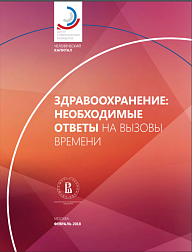
The CSR and NRU HSE have prepared the report entitled Healthcare: Necessary Responses to Current Challenges devoted to Russia’s responses to current challenges related to the nation’s health protection. The proposed targets for the development of health in Russia in 2018-2035. are presented in the following table:
Meanwhile, Russian medicine is far behind technologically from healthcare of Western countries. Such a situation is dangerous because in the modern world it is healthcare that replaces the military sphere as the main platform for technical progress and turns into the largest branch of the most developed economies. New medical and information technologies (molecular genetic diagnosis, bioinformation analysis of genomic and biomarker data, gene therapy, cell engineering, etc.) are created in the 21st century by new health products and services markets.
The authors of the report see the following key actions necessary for the healthcare industry:
1. Technology breakthrough
2. Promoting health living
3. Ensuring the availability of quality medical services
4. Developing talents
5. Establishment of an effective drug supply system
6. Improving financing efficiency.
A technology breakthrough in healthcare is planned to be implemented through the support of new medical technologies, introduction of innovative management models and establishment of centres for export of high-tech medical services.
To this end, it is proposed to launch state programs on the development of biomedicine and support for start-up projects in the healthcare industry (2018-2024), and also to train personnel in the development and operation of medical equipment. In parallel, personal information of patients should be digitised, citizens should be motivated and trained to use new medical and information technologies, it is necessary to ensure the development of personal health monitoring, create a multi-level system for telemedicine consultations.
According to the authors, Russian medicine has good chances for exporting medical services to high-tech centres in the following areas:
-
neuroscience combined with educational services;
-
cross-border diagnostic services;
-
high-tech surgery and rehabilitation;
-
immunotherapy of oncological diseases.
Strengthening a healthy lifestyle includes government support for civil initiatives to involve public in physical education and sports, continued implementation of the alcohol policy, consistent implementation of measures to keep the prevalence of tobacco smoking low and, of course, promotion of healthy food.
To improve the quality and accessibility of medical services, structural changes and formation of integrated healthcare, including the disaggregation of medical units and introduction of a new general hospital model of the district service, implementation of new programs for managing patients with chronic diseases, increase in high-tech medical services and other measures are important.
There should be three areas of human resources development: improving the vocational education system (creating university clinics, attracting leading foreign specialists and Russian doctors who have received vocational education abroad, etc.), updating knowledge of HCPs (independent accreditation, continuous supplementary education, training healthcare managers in economics and management) and strengthening of labour motivation (maintaining and increasing wages of HCPs after reaching planned targets in 2018).
The establishment of an effective drug supply system includes, first of all, the optimisation of the drug therapy, emphasis on the drugs with proven clinical effectiveness only. The authors of the report pay special attention to medicinal provision of outpatients with cardiovascular diseases, as well as bronchial asthma, chronic obstructive pulmonary diseased, and diabetes. State financing of preferential drug provision should be made at reference prices.
Effectiveness of healthcare financing will be improved by the transition from insurance in name, and distributive, in fact, system of financing medical services to the system that insures health and encourages its participants to increase efficiency. To this end, the first stage (2018-2019) should be focused on increasing the evidence of financial resources distribution in healthcare and transparency.
The second stage (2020-2023) should target the development of competition between medical organisations in the MHI system (where possible) and introduction of methods for paying for medical care under the MHI, which increases the motivation of medical organisations to expand prevention methods, more effectively manage patients with chronic diseases, ensure integrated inpatient treatment and post-treatment in outpatient settings, etc.
It is also advisable to test new financing mechanisms in several pilot regions that ensure the development of insurance principles in the MHI system. The resources needed to implement this health development strategy are presented in the table Public Spending on Health in Functional Areas, GDP %.