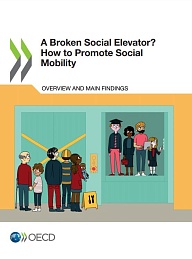
The report by the Organization for Economic Cooperation and Development (OECD) reveals that with the current levels of social inequality and intergenerational income mobility, in an «average OECD country» it may take five generations for children of poor families to reach the average income in their country, or about 150 years. There are, however, very large variations in earnings mobility: for instance, in the Nordic countries it takes only two or three generations for a person from a low-income household to reach the mean income, but nine or more generations in emerging economies. Every third child born from a low-income father will have low income as well. Two-thirds of people with low-earnings parents succeed to move to a higher status, but for almost half among them, upward earnings mobility is limited to the neighboring earnings group.
.png)
Social mobility, notably in terms of earnings across generations, is usually lower in high-inequality countries (for instance, in Latin American countries, and in some emerging economies), and higher in low-inequality countries (for instance, in most Nordic countries). Upward mobility for people with lower educated parents tended to increase for individuals born between 1955 and 1975, but then stagnated for those born after 1975. Over a four-year period, about 60% of people remain stuck at the bottom 20% of the income distribution. At the top, the persistence of advantages is even stronger 70% remain there for four years.
OECD experts recommend that governments should design policies to grant all children equal opportunities. The practical steps suggested to support social mobility include increasing public investment in health and education, especially early education and care, and family policies. Fostering social mobility also requires policies to reduce regional divides and spatial segregation in cities. This necessitates a range of local development and urban planning policies including measures for transport and housing. Policies affecting wealth accumulation and savings behavior are an important tool for enhancing social mobility. Avenues to rebalance opportunities would be to limit wealth, inheritance and gifts tax avoidance, design progressive tax systems with adequate rates and reduce exemptions.
.png)
This report is part of the OECDs broader Inclusive Growth Initiative, that has just released its Framework for Policy Action, with a dashboard of indicators, and policy tools that have been effective at addressing inequalities.