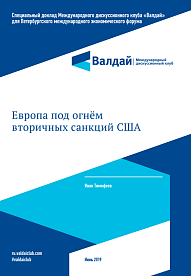
This report of the Valdai Discussion Club was specially prepared for the St. Petersburg International Economic Forum 2019.
According to the authors of the report, politically and militarily, the modern world has been multipolar for quite long, but economically, the world remains unipolar. The US ability to use coercive economic measures is considerably higher than that of all other countries, and so major foreign companies involved in dollar transactions and reliant on the US market defer to American demands even where their own governments are critical of US actions. This is why the US remains the leader in imposing unilateral economic sanctions. Washington leads both in the number of sanctions and the sheer might of the government machinery involved in enforcing them.
During the past three decades, however, such sanctions are increasingly exterritorial in application, hitting companies and organizations from numerous other countries. The fact that exterritorial sanctions are possible at all is due to the dominant position of the US financial system in the context of international financial transactions and the close links that many major companies have with the US market. All foreign players who have some degree of relationship with US financial institutions, companies, or markets come under US national law. Apart from purely economic benefits, this global economic role gives the Americans powerful political leverage.
.png)
Despite its economic clout and growing number of sanctions programs, the EU is still no match for the US in terms of leverage. The European Union has been attempting to do something to protect itself from US secondary sanctions since at least the early 1990s. A powerful incentive was furnished by the US withdrawal from the Joint Comprehensive Plan of Action (JCPOA) on the Iranian nuclear program. Washington has unilaterally resumed large-scale financial and sectoral sanctions against Iran. As a result, a large number of companies operating on the Iranian market, including European firms, are threatened with secondary sanctions and subsequent fines. The EU has reintroduced the so-called Blocking Statute (1996) supposed to protect European companies from secondary sanctions. But numerous EU companies have already left Iran.
In todays world, there are at least two major economic centers that are strong enough to create an alternative system of settlements so as to shield themselves from US sanctions. These are the EU and China. However, the authors believe that both the EU and China lack any serious motives to create a global alternative in the nearest future. But this does not mean that China will not be compelled to move in this direction in the future, especially if the competition between China and the US picks up momentum. Washington can go beyond the trade war by imposing sanctions to contain Chinas technological development. In this case, China could take extensive measures in response. However, in the authors opinion, nothing suggests that this scenario will actually materialize, at least in the next few years.