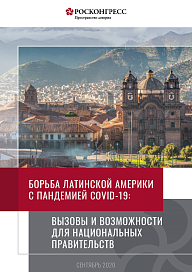
The Roscongress Foundation has published its own comprehensive study entitled ‘Latin America’s fight against the pandemic: challenges and opportunities for national governments’. The Directorate for International and Regional Cooperation analyzed the social, cultural, economic, and political processes in the region. One of the key sections of the analytical review, ‘Transforming Latin America’s Energy Landscape under the Impact of the Pandemic’, was prepared together with Sergey Brilev, President of the Global Energy Association.
The crisis caused by the COVID-19 epidemic was a major test for Latin America: despite the delay in the spread of the disease compared to Asia and Europe, the region was unable to make use of this temporary advantage. On 23 May, Latin America was declared the new Coronavirus epicentre and countries in the region were equally affected by the pandemic.
The lack of integrated regional mechanisms and strategies to address the socio-economic impact of the pandemic is one of the key vulnerabilities in Latin America, stemming from a more general problem: the systemic integration crisis. This trend is to some extent offset by the multifaceted humanitarian links with extra-regional actors, including Russia. One of the most important areas of anti-crisis cooperation between Russia and Latin America promises to be the supply of Russian medicines for both coronavirus treatment and vaccination.
The study ‘Latin America’s fight against the pandemic: challenges and opportunities for national governments’ focuses on the regional specifics of the response to the pandemic and the uniqueness of social processes in the new environment. For example, at the beginning of the crisis in countries with strong presidential powers, the heads of state grew even more powerful. Moreover, the emergency situation required a maximum reduction in the time for decision-making in all areas, causing an inevitable shift in the separation of powers towards a weakening of the legislature.
The crisis triggered by the pandemic has affected all the energy sectors in the region that are expected to be vulnerable to the consequences of global energy turbulence. As a result, they are likely to fall further behind global trends: the progressive elimination of fuel subsidies, reduction of CO2 emissions, improvement of hydrocarbon production technologies in terms of environmental damage, and increasing the share of renewable energy in energy production. At the same time, the study notes the significant potential for national economies to recover from the COVID-19 crisis, embedded in clean energy and capable of redirecting economic incentives towards a more sustainable development model.