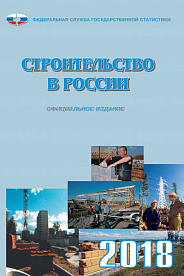
The report gives statistical data for Russia as a whole, but also includes some indicators of the construction sector and investments in other countries as reference data.
The Russian construction sector is currently stagnating, which is evidenced by the main economic indicators. The volume of works falling under the ’Construction’ type of economic activity is growing in actual prices (RUB 7545.9 bn in 2017 against RUB 1754.5 bn in 2005), but, when measured as a percentage of the volume of works done in the previous year, the figures are going down. A similar situation is seen in fixed capital investments channelled into the development of construction. The share of investments in construction has decreased from 3.6% in 2010 to 2.2% in 2017. The profitability in construction remains relatively low (3.8%) while the economy-wide average is twice higher. Another problem of the construction sector is the depreciation of machines and equipment. Of the economy-wide average of 27%, 26.4% is accounted for by the construction sector. This problem results from insufficient investments.
The most common form of ownership among the existing construction organization is private property, it accounts for 99.1% of all organizations in the construction sector in 2017. As for the structure of works performed by the organizations using their own resources under all types of economic activity, the greatest share in 2017 fell under engineering construction (40.4%), including road and railroad construction, and construction of utility systems; construction of buildings (residential and non-residential; 35.2%); and specialized construction works (24.4%).
The compilation identifies the main factors that hinder the operations of construction companies.
The authors of the compilation also examine production and imports of the main products used in construction. Among the domestically manufactured construction products, the most important are: plastic door units and door sills (1151 thousand square meters in 2017), windows and wooden frames (621 thousand square meters in 2017), roll roofing materials and waterproofing materials (459 million square meters in 2017). The main imported products are pebbles, grit, and stone chips or crushed stone, for which the volumes of import have increased twofold since 2005 reaching 15,335 thousand tons in 2017.
The compilation also includes statistical data on construction and investment in foreign countries. It provides indicators which make it possible to compare the trends in Russia with those in other countries in terms of investment processes (gross fixed capital formation) and the development of residential construction (commissioning of apartment houses, numbers of apartments built and their average size).
Close