The global risks landscape
The 15th edition of the Global Risks Report draws on feedback from nearly 800 global experts and decision-makers who were asked to rank their concerns in terms of likelihood and impact for countries or industries. All existing global risks were grouped into five categories: economic, environmental, geopolitical, societal, and technological.
The global threats landscape, as presented in the report, includes the following:
- geopolitical instability,
- economic concerns,
- climate response shortcomings,
- biodiversity loss impacts,
- technological governance,
- creaking health systems.
Short-term risk outlook
The Global Risks Report forecasts a year of increased domestic and international divisions with the added risk of economic slowdown. 78% of survey respondents said they expect «economic confrontations» and «domestic political polarization» to rise in 2020. Global experts also see the risk of extreme heat waves and destruction of natural ecosystems increasing, as well as a rise in cyber-attacks targeting operations and infrastructure and data/money theft. Over 87% of Global Shapers (members of The Global Shapers Community the World Economic Forums network of young people driving dialogue, action and change) expect an increase in risks of extreme heat waves, destruction of ecosystems, health impacted by pollution.
A sharper focus on environmental threats
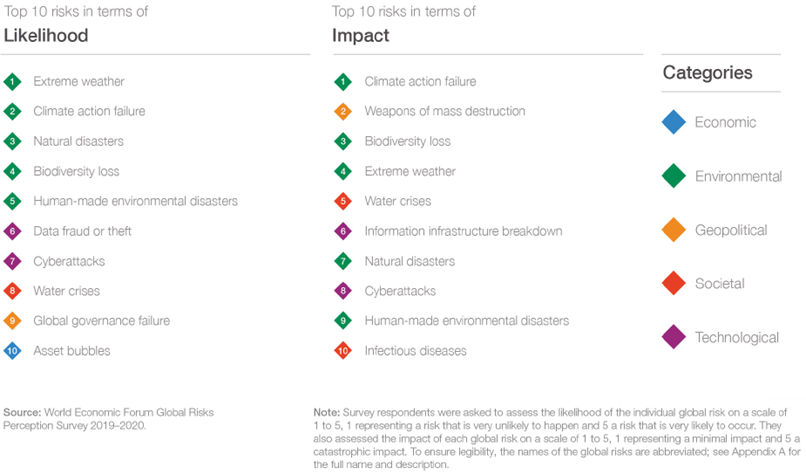
Concerns about environmental risks have been rising over the last decade. For the first time in the history of the surveys 10-year outlook, environmental threats dominate the top five long-term risks by likelihood and occupy three of the top five spots by impact. The remaining two risks in the top five in terms of impact are weapons of mass destruction and water crises.
A need for adaptive geopolitics
As the outlines of the next geopolitical era start to emerge, there is still uncertainty about where the distribution of power will settle and from where influence will emanate, but a snap back to the old order appears unlikely. Instead, longstanding institutions must adapt to the present and be upgraded or reimagined for the future. One example is the Franco-German «Alliance for Multilateralism», a group of nations working to boost international cooperation in areas such as disarmament, digitalization and climate change.