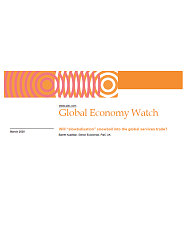
The publication by PwC studies the current trends and issues in the global services market arising from the spread of the coronavirus pandemic and a slowdown in the global economy — the so-called «slowbalisation».
The Roscongress Foundation presents the salient points of the publication accompanied by fragments of broadcasts of relevant panel discussions from the business programme of key international events held by the Roscongress Foundation.
Spread of COVID-19 shows how integrated the global economy is
The authors of the publication point out that China currently accounts for almost 20%, and for about 11% of total global exports (goods and services). In the aftermath of China’s entry to the World Trade Organization (WTO) in 2001, businesses are increasingly reliant on supply chains that include China. The South East Asian economies are more reliant on China as a source of input to their exports, compared to the other advanced economies in the West. A slowing down of the South Eastern economies could have a large impact on global GDP growth. This proves that COVID-19 is a risk that should be actively monitored by businesses and policymakers around the world.
Video: https://roscongress.org/sessions/globalnaya-sistema-torgovli-chto-dalshe/translation/
Businesses should start upskilling the workforce today to avoid shortage of skilled labor
PwC’s Global CEO Survey shows that more than 8 out of 10 CEOs are concerned about the availability of skills. This trend is driven by three factors: first, a smaller pool of available workers from which businesses can hire; second, higher retirement age in some advanced economies; and third, higher rates of automation which have the potential to displace jobs. This is why PwC analysts stress the importance of reaching the objective of upskilling one billion people by 2030 with a focus on workers whose tasks are likely to be automated.
Uncertainty in the global trade arena continues to be a source of concern for many businesses
Developing countries are starting to take the lead on the services market. China was the world’s 5th largest services exporter in 2018. China is also the world’s largest source of international tourists. In 2018, Chinese tourists made 150 million outbound trips and accounted for around a fifth of global tourism spending. Depending on how long travel restrictions into and out of mainland China continue, this could have significant consequences for to the international travel and tourism sector. In the short term, PwC analysts expect a slowdown in the largest services exports sector, travel, due to COVID-19. In the medium to long term however, the outlook for services exports is more positive. The PwC experts believe that continued technological breakthroughs, coupled with the spread of faster and cheaper internet connections, mean that newer, more specialised services will continue to be developed, and that it will likely be easier to trade these across borders.
For more information about policy responses to the coronavirus outbreak and possible ways to stabilize the economy during the pandemic, please see the COVID-19 and StayHomeEconomy special sections of the Roscongress information and analytical system.