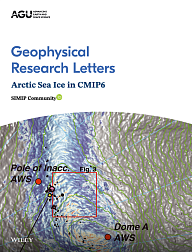
This paper by the American Geophysical Union (AGU) forecasts future Arctic sea-ice area and volume evolution. Projections are based on Arctic sea ice simulations generated by the Coupled Model Intercomparison Project (CMIP6). CMIP6 is a global climate multimodel that uses a number of variables such as cumulative anthropogenic CO2 emissions, changes in GMST (global mean surface temperature), etc to capture and forecast changes in Arctic sea-ice coverage.
The Roscongress Foundation presents the salient points of the publication accompanied by fragments of broadcasts of relevant panel discussions from the business programme of international events held by the Roscongress Foundation.
The Coupled Model Intercomparison Project (CMIP6), the latest generation of global climate models, produces simulations of Arctic sea-ice area and volume evolution.
In recent decades, Arctic sea-ice area has decreased rapidly, and the signal of a forced sea ice retreat has clearly emerged from the background noise of year-to-year variability.
In this publication, the authors extend earlier studies that examined model performance in the third and fifth phases of the Coupled Model Intercomparison Project (CMIP3 and CMIP5) by examining model simulations from the sixth phase of the Coupled Model Intercomparison Project (CMIP6), the latest generation of global climate models. For CMIP6, the Sea-Ice Model Intercomparison Project (SIMIP) designed a specific set of diagnostics that allow for detailed analyses of sea ice related processes.
Internal variability causes a large spread of plausible climate trajectories, which must be kept in mind when interpreting simulations.
Sea-ice parameters such as total sea-ice area and total sea-ice volume are highly variable depending on season, length of observation period, etc.
The authors note that internal variability causes a large spread of plausible climate trajectories in response to a given change in the forcing and must carefully be considered when interpreting a possible mismatch between a simulation and a given observational sea ice record.
For the analysis of the simulated sensitivity of Arctic sea ice to changes in external forcing, the researchers calculate two distinct quantities: first, the change in sea-ice area for a given change in cumulative anthropogenic CO2 emissions over the period 1979–2014 and second, the change in sea-ice area for a given change in GMST (global mean surface temperature) over the period 1979–2014.
In the vast majority of models, the Arctic Ocean becomes practically sea-ice free by 2050.
In analyzing the future relationship between sea-ice loss and changes in the forcing, the authors find that the simulated correlation between winter Arctic sea-ice area and cumulative CO2 emissions remains high well into the future.
It is important to note that CO2, while being the most important external driver of observed changes in Arctic sea-ice coverage, is not the only cause of observed and future changes. Its dominant role, however, holds well into the future and/or the additional impacts of other anthropogenic forcings, such as methane and aerosols, remain roughly stable over time.
The authors find that in the vast majority of the available CMIP6 simulations, the Arctic Ocean becomes practically sea-ice free in September for the first time before 2050.
This paper is part of Geophysical Research Letters. See full version of the journal here.
For more information about rational use of Russia’s natural resources and the development of the Arctic region as a strategic goal for economic and social welfare, please see the Environment, The Arctic, and Basic Research sections of the Roscongress information and analytical system.