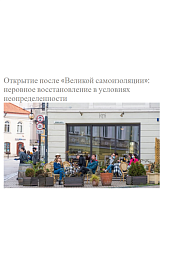
Experts from the International Monetary Fund (IMF) presented the article that examines the recovery process in some countries after the «Great Self-Isolation» regime. The forecasts assume cumulative losses to the global economy as a result of the crisis of over USD 12 trillion over two years (2020–2021). IMF sources expect a longer period of social distancing in 2H 2020 and damage to potential supply.
The forecast from the IMF is characterized by a significant degree of uncertainty, with the possibility of changing the situation for both the better and the worse. On the positive side, better news on vaccines and therapies, and additional policies to support growth, could accelerate economic recovery. On the downside, new waves of infection have the potential to reverse the rise in mobility and costs, and trigger a rapid tightening of financial conditions, which could create a debt crisis. The IMF estimates that the unprecedented global scale of the crisis is hampering economic growth in export-dependent countries and jeopardizing prospects for income convergence between developing countries and advanced economies. At the same time, with the resumption of the economy, the activity recovery is uneven.
The labor market situation has worsened very seriously in record time — especially for relatively low-paid and semi-skilled employees who are unable to work remotely. On the positive side, the recovery is considered to be based on the exceptional policy support, especially in advanced economies and to a lesser extent in emerging and developing countries with more limited fiscal space. Special support, particularly from leading central banks, is stimulating a dynamic recovery in financial conditions, the heavy situation in the real sector. Given the enormous uncertainty, governing bodies need to remain attentive and make policy changes as the situation evolves.
IMF’s calculations show that the top priority problem is resolving health risks to residents at the time when states are recovering economic activity. This will require further strengthening of healthcare capacity, extensive testing, contact tracing, isolation and maintaining a safe distance. These activities can help curb the spread of the virus, give the population confidence in the ability to systematically prevent new outbreaks, and also minimize disruptions to the economy. More should be done to ensure the production and distribution of vaccines and medicines, once developed, in sufficient quantities and at affordable prices. In this context, in countries that have begun to lift restrictive measures and are experiencing economic recovery, support measures should be reoriented over time to encourage people to return to work, as well as to facilitate the transition of employees from shrinking industries to sectors with growing demand.
Public debt is projected to reach its highest relative to GDP this year since record-keeping in advanced economies as well as emerging and developing economies. The crisis presents an opportunity to accelerate the transition to more productive, sustainable and equitable growth through investments in green and digital technologies and broader social safety nets. Global cooperation is now more important than ever in overcoming a truly global crisis.
See other materials, placed in special sections of the Information and Analytical System Roskongress StayHomeEconomy, economic progress, digitalization and modern consumer, on possible ways to stabilize the economy in the pandemic, the economic development and digitization, as well as the tendencies of the modern consumer.