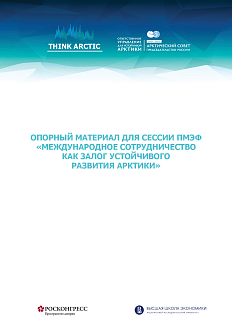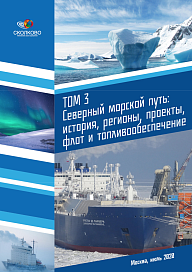
Task force Arctic Energy at the Energy Centre of the Moscow School of Management SKOLKOVO present the third volume of study series Arctic Energy dedicated to development of the Northern Sea Route (NSR), logistics and fleet. The study addresses main changes in transport infrastructure of the Russian Arctic, including adherence to environmental agenda providing for stricter environmental regulations concerning marine emission.
The Roscongress Foundation presents the salient points of the publication accompanied by fragments of broadcasts of relevant panel discussions from the business programme of international events held by the Roscongress Foundation.
Recent years can witness significant changes in the transport infrastructure of the Russian Arctic. Industrial production growth leads to fast transformation and complication of logistic schemes.
LNG export terminals are built in Murmansk and Kamchatka, coal export terminal is planned to be built in Indiga. Implementation of railway projects, including Northern Latitudinal Railway and Belkomur, shall influence transportation load.
A building yard for gravity based structures in terms of LNG production projects is being constructed to ensure industrial development in the Arctic. Once LNG production projects are complete, the yard may be used for production of gravity based structures in terms of other projects, including at the shelf.
Innovative floating solutions are implemented for floating nuclear power station Akademik Lomonosov, and floating LNG power stations are considered as an energy source for the new mining projects at the Chukchi Peninsula.
Long-term project sustainability will be influenced by the global market situation and global environmental and climatic regulation. And the Arctic, being the most sensitive region, is subject to the strictest environmental regulations.
In the recent years, marine fuels are subject to active environmental regulation. Since 2020, international regulations concerning marine emissions are becoming stricter. According to the authors, such trend shall continue in future.
Because IMO actively promoting the idea to forbid use of heavy fuel oil (HFO) in the polar waters, a mistake in strategic selection of fuel for the new watercrafts may lead to multi-billion losses, or even for the projects to be stopped with investment losses for the sponsors. Oil and coal tankers, Norilsk Nickel fleet, transit and fleet for the planned industry projects in the Arctic are in the risk zone.
Shipowners and fleet operators in the Russian Arctic face a difficult strategic decision. Use of distillate fuels shall immediately lead to increase in operational expenditures, and a scrubbing unit installation may be an inadequate investment in case of restrictions in use of residual fuel in the Arctic, so the investments will not be recovered. Shipowners face even greater risks during new vessels building that requires high capital investments.
In terms of uncertainty in deadlines for introduction of strict environmental regulations for arctic maritime traffic, defining vector in development of shipbuilding and fleet reequipment (improvement) is a strategic decision that influences development not only of the shipbuilding industry in Russia but also the industrial strategy in the Russian Arctic for the next 40 years.
Selection of vector in development of the Russian arctic fleet influences successful implementation of the Russian industrial strategy in the Arctic, and will determine efficiency and environmental security of major Russian production and transportation projects (for example, transit over the NSR). Russia may put forward an initiative to forbid use of any petroleum fuels in the Arctic, and it shall lead not only to additional income from LNG sale at the domestic market but also become an incentive for building of hundreds of vessels at the Russian yards, and a leverage on maritime traffic in the Arctic.
Video: https://roscongress.org/sessions/eef-2019-shelf-rossii-nuzhno-li-ego-osvaivat-/search/#00:34:33.344
For more information about construction as a sector with a sizeable share in many economies, rising level of digitalization, and shifts in consumer sentiment in real estate, please see the The Arctic, Environment, Transit Potential and Shipbuilding.