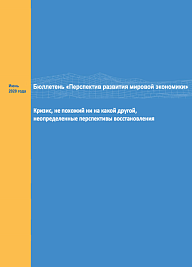
IMF experts present a forecast for global growth, in particular with regard to pandemic-induced disruptions to economic activity, commodity prices, financial conditions and government support. As with the forecasts for the April 2020 World Economic Outlook (WEO) 2020, the forecast is more uncertain than usual. The baseline forecast is based on key assumptions about the impact of the pandemic.
Roscongress Foundation analysts highlighted the main theses of this research, accompanying each of them with suitable fragments of video broadcasts of panel discussions held as part of business programs of the key events hosted by the Foundation.
In 2020, the world economy is projected to grow at — (minus) 4.9 percent, 1.9 percentage points below the April forecast. However, financial conditions, which have eased since the April 2020 WEO, are expected to remain broadly at current levels.
The COVID-19 pandemic has had a more negative impact on economic activity in the first half of 2020 than expected, and the recovery is projected to be more gradual than previously thought. Global growth is projected at 5.4 percent in 2021. As a consequence, overall GDP in 2021 will be about 6½ percentage points lower than in January 2020 forecast, before the COVID-19 pandemic.
Moreover, financial conditions, which have eased since the April 2020 WEO, are expected to remain broadly at current levels. The study authors note that the results may be different than envisaged in the baseline scenario, and not only due to how the pandemic spreads.
In oil exporting countries, after a rapid decline in fuel prices, a sharp decline is predicted, including in Russia (-6.6 percent). However, the implementation of the forecast presented by the IMF experts depends on the depth of the recession in the second quarter of 2020 (for which there are no complete data yet), as well as the scale and duration of the negative shock.
In 2020, for the first time, all regions are forecast to have negative growth. However, indicators differ significantly for individual countries, depending on the pandemic evolution and the effectiveness of containment strategies, differences in the structure of the economy (for example, dependence on hard-hit sectors such as tourism and oil), reliance on external financial flows, including remittances, and pre-crisis growth trends.
In China, which is recovering from a sharp decline in the first quarter, growth is forecast to reach 1.0 percent in 2020, thanks in part to stimulus measures. India’s economy is forecast to contract 4.5 percent after a longer period of self-isolation and a slower recovery than expected in April. In Latin America, where most countries are still struggling to contain the spread of infection, the economies of the two largest countries, Brazil and Mexico, are projected to shrink by 9.1 and 10.5 percent, respectively, in 2020.
Global trade will decline deeply this year at —11.9 percent due to significantly weaker demand for goods and services, including tourism. With a gradual increase in domestic demand, trade growth is expected to pick up around 8 percent next year.
Inflation forecasts have generally been revised downward, with the most significant declines typically occurring in 2020 and in advanced economies.
The international community must significantly increase its support for national initiatives, including through financial assistance to countries with healthcare disabilities and funding for vaccine production. However, active multilateral cooperation will continue to play the main role in many areas.
Countries facing a healthcare crisis and external funding gaps need assistance to secure liquidity, including through debt relief and funding through the global financial safety net.
All countries, including those that have already passed peak infection rates, should provide their own healthcare systems with sufficient resources and fund the production of vaccines as the results of their trials are achieved, so that all states can quickly obtain the vaccine in sufficient quantities and at an affordable price.
Where self-isolation is needed, economic policies should continue to mitigate household income losses through significant targeted measures, as well as provide support to companies affected by restrictions on economic activity.
To prevent a recurrence of this disaster, the world must urgently build up global stockpiles of essential supplies and protective equipment, fund research and support health systems, and create effective mechanisms to help those most in need.
See other materials posted in special sections of the Roscongress COVID-19 Information and Analytical System, Entrepreneurship, StayHomeEconomy and Financial Market , dedicated to possible ways to stabilize the economy in a pandemic and support the main areas of economic activity during the period of adaptation to post-crisis reality.